
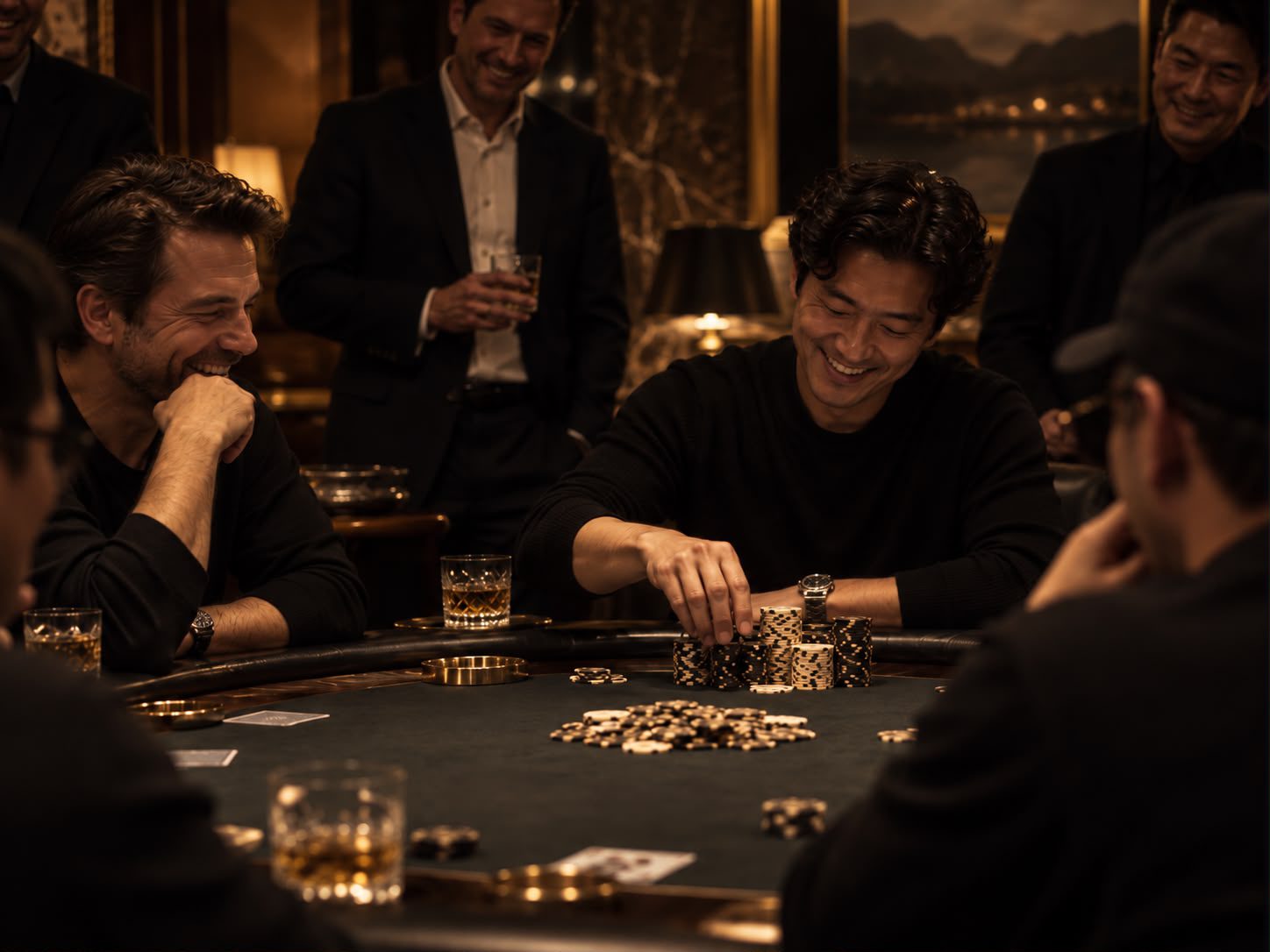
There is a skill in live poker that almost nobody studies.
It has nothing to do with ranges.
Nothing to do with blockers.
Nothing to do with solver outputs.
It is what happens after you win the pot.
Especially a big one.
You stack someone.
You show a bluff.
You make a thin value bet and get paid.
For you, the hand is finished.
For the other person, sometimes it isn’t.
They may still be processing the money.
The embarrassment.
The fact that everyone just watched them get bluffed.
Or the fact that they made a hero call and were wrong.
And what you do in the next 20 seconds can determine whether they laugh, tighten up, get uncomfortable, leave ,
or actually enjoy continuing to play with you.
That is social EV.
And in live poker, social EV is real EV.
⸻
The Second Pot
Every big hand has two pots.
The first pot is the chips in the middle.
The second pot is the emotional aftermath.
Most serious players spend thousands of hours learning how to win the first one.
Almost nobody studies the second.
Imagine you just ran a huge river bluff.
Your opponent tanks for three minutes.
Finally, he folds.
You show.
The table erupts.
Now what?
The worst thing you can do is start giving a lecture.
“I was bottom of range.”
“Your flop sizing looked weak.”
“Once you checked turn I knew you couldn’t have it.”
Please don’t.
You already won the pot.
You don’t need to win the post hand analysis too.
Technically, you won.
Socially, you may have just made the other guy feel like an idiot in front of the whole table.
He didn’t only lose money.
He lost face.
There is a difference.
⸻
Silence Is Good. But It Isn’t Always the Best You Can Do.
The safe option is simple:
Stack your chips and say nothing.
And sometimes that is exactly right.
But I think a really good live player can do more.
He can diffuse the situation.
You hear regulars say this all the time:
“Very lucky, very lucky.”
“Today I’m super lucky.”
“Today is my lucky day”
I say it too.
And I actually like it.
Because it subtly reminds everybody:
This isn’t me standing above you saying I am better than you. Poker has luck too.
You’re lowering the temperature.
⸻
After a Bluff
Bluffing is probably the most sensitive situation.
Because when you bluff someone, the message can easily become:
I fooled you.
I owned you.
Fun for you.
Not necessarily fun for them.
So after a big bluff, I like a little vulnerability.
Maybe a nervous grin before showing.
“Phewwww.”
“My heart was at 150 bpm.”
“Fuck, I thought you were going to call.”
Notice the difference.
You are not saying:
I owned you.
You are saying:
That was a battle.
The chips still come to you.
But the other player gets to keep some dignity.
That is a great trade.
And please don’t immediately explain the bluff unless they ask.
If someone punches you in the face, the last thing you want is for him to explain the biomechanics of why the punch landed.
Same thing.
Stack the chips.
Smile.
Move on.
⸻
After a Big Value Bet
Value is slightly different.
They call.
You turn over the hand.
Again, you don’t need to perform.
Sometimes:
“Today I’m lucky.”
Or
“I got it , bro”
Or just a smile.
What I don’t like is fake sympathy.
If someone made a terrible call, don’t look at them and say:
“Wow bro, such a difficult spot. I probably call too.”
When everybody knows you wouldn’t.
People can feel that shit.
It becomes condescending.
You don’t need to comfort them.
You need to respect them.
And there is one sentence I almost never want to hear after winning:
“You should have…”
You should have folded.
You should have called.
You should have raised.
Who cares?
You already got the chips.
⸻
Let People Save Face
This isn’t really a poker concept.
It’s a human concept.
People hate losing status in front of other people.
And at a live poker table, there is always an audience.
So sometimes give someone an escape route.
If you value bet them:
“This time I had it.”
If they folded to your bluff:
“I got lucky you folded this one.”
You are not pretending they played perfectly.
You are just giving them a socially acceptable way to process the hand.
Strong communicators do this everywhere in life.
They let people keep their dignity.
⸻
Dangerous Player. Pleasant Person.
This might be the strongest persona you can have in live poker. A name come to my mind when i think of such persona. Punnat punsri is like this. Dangerous guy to have on the table yet a very humble pleasant guy. My idol!
Inside the hand?
Be ruthless.
Three bet them.
Pressure them.
Overbet rivers.
Run bluffs.
Thin value bet them.
Do whatever poker requires.
Once the hand ends?
Become warm again.
The aggression belongs to the hand.
It doesn’t need to become your personality.
There is a big difference between:
“He plays aggressively.”
and:
“He is an aggressive person.”
The dream reaction is:
I fucking hate playing pots against this guy…
followed immediately by:
…but I like having him at the table.
Dangerous player.
Pleasant person.
⸻
And Learn How to Lose
This is the other half that I think pros sometimes miss.
If you want people to enjoy losing to you, you also have to know how to lose like a human being.
Someone bluffs you?
Laugh.
“You got me, motherfucker. What’s your name?”
“Okay. Now I’m targeting you.”
You get coolered?
You don’t need to become Buddha.
Complain a little.
“Brooooo, come on.”
Laugh.
Shake your head.
Move on.
I actually think showing some emotion is good.
Imagine a recreational player gets sucked out on and wants to throw his chair.
Then a professional loses the exact same pot and sits there completely expressionless.
Stoic as fuck.
Sometimes that doesn’t make you look cool.
It makes you look like a machine.
And machines are scary to play against.
If I make a terrible hero call, I might just laugh:
“Yep. I am Super pro. Promotion ! .”
Now everyone gets to laugh with me.
Poker becomes a game again.
⸻
Control the Emotional Weather
Every poker table has emotional weather.
Some players make everything tense.
Some make everyone quiet.
Some turn every big pot into an ego battle.
And then there are players who somehow make millions moving across the table feel light.
They win a massive pot and nobody hates them.
They bluff someone and the victim laughs.
They lose and the game keeps flowing.
They know when to speak.
When to shut up.
When to joke.
And when somebody needs 30 seconds of silence.
That isn’t random charisma.
That is emotional intelligence.
And especially in private games, streamed games and high stakes live poker, your reputation eventually becomes part of your bankroll.
People remember who was fun.
Who was miserable.
Who embarrassed people.
Who played like a robot.
And most importantly:
Who everybody wanted back.
You might win $100,000 from somebody tonight.
But there is another question:
Will he happily sit with you again next month?
If the answer is yes, you probably played the second pot pretty well.
⸻
The stronger you become at poker, the less you need everyone to know how strong you are.
You don’t need to prove you soul read someone.
You don’t need to be so robotic and emotionless.
Sometimes you just smile.
Stack the chips.
Because the goal isn’t only to win the pot.
Win the pot.
Don’t lose the table. 🤓